Bibimbap is the rare Korean dish whose name is also its instruction manual. Bibim means "mixed," bap means "cooked rice" — and the whole point, the part first-timers at Korean restaurants reliably get wrong, is that you are supposed to destroy the beautiful arrangement. Mix it. All of it. The photogenic wheel of vegetables exists to be stirred into chaos with a spoonful of gochujang.
Maangchi's bibimbap recipe — her video for it has been watched over a million times, and the recipe holds a 5 out of 5 rating from more than 1,100 readers — is the version to learn from, because she is honest about both the long road and the shortcut.
The classic bibimbap recipe is a platter project
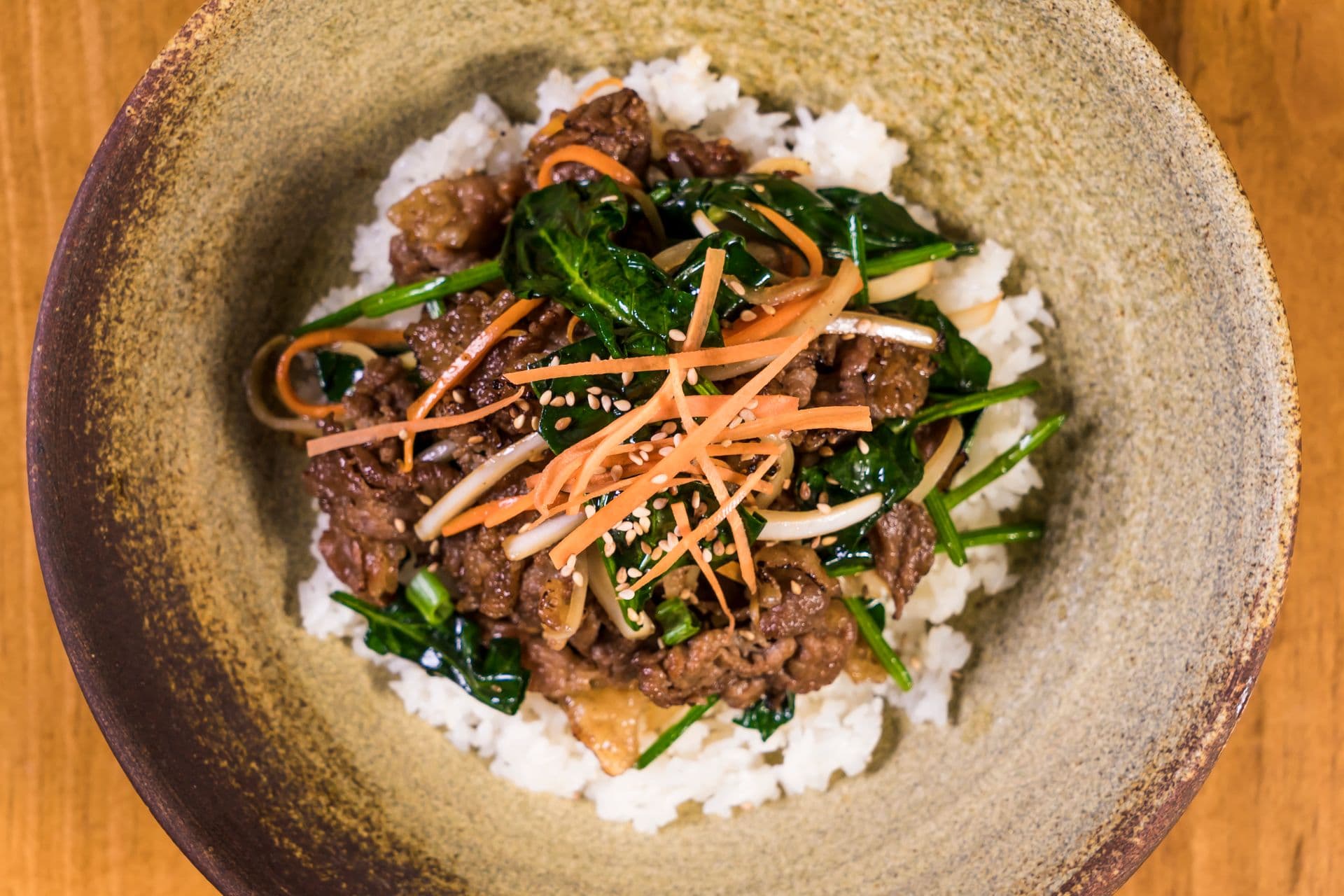
Full classic bibimbap, per her April 2025 update, is an afternoon: soybean sprouts boiled and seasoned, spinach blanched and dressed with garlic and sesame oil, carrot, zucchini, and cucumber each salted, squeezed, and sautéed separately, bellflower root (doraji) soaked up to 24 hours, fernbrake (gosari) that needs 30 minutes in a pressure cooker or an overnight soak, beef cut into matchsticks and marinated in soy, honey, garlic, and sesame oil. Each vegetable is cooked alone, in the same pan, wiped clean between rounds. That separateness is the philosophy — every ingredient keeps its own flavor and color until the final mix.
Two parts of the recipe tend to get skipped. The first is the rice: 2 cups of short-grain rice makes about 5 cups cooked, enough for four bowls. Rinse it until the water runs fairly clear, soak it in 2 cups of water for 30 minutes, cook over medium-high heat for 7 to 8 minutes until it is spluttering, turn it over with a spoon, then give it 10 minutes on very low. The second is the soup. The soybean sprouts boil for 20 minutes in 4 cups of salted water, and instead of draining them all, you leave about half a cup of sprouts in the pot. That water becomes the small bowl of bean sprout soup served alongside.
The honest shortcut — six unskippable items
Here is the paragraph of her recipe that deserves more attention: if you are in a rush, Maangchi says you can make a great bibimbap with just soybean sprouts, spinach, carrot (or red bell pepper), gochujang, toasted sesame oil, and an egg. Those are, in her word, unskippable. Everything else — the gosari, the doraji, the beef — is depth, not foundation. A weeknight bowl with the core six takes under an hour including rice — and it is a legitimate bibimbap, not a compromise version.
Where bibimbap comes from — and why Jeonju owns it
Nobody knows exactly where bibimbap started. The earliest name on record is hondon-ban, in a text written around 1590, and the first known recipe sits in Siuijeonseo, a late-19th-century cookbook. The origin theories all point at the same practical instinct. One ties it to ancestral rites, where the food offerings were mixed together in one bowl afterwards. Another describes farmers' wives with no time for a table of side dishes, combining everything in a single bowl instead. And on the eve of the lunar new year, ordinary households mixed the year's leftover side dishes into rice so nothing carried over. Daniel's "leftovers engineering" line below has a long history behind it.
Several cities have their own version. Jeonju bibimbap cooks its rice in beef shank broth, tops it with soybean sprouts, hwangpo-muk (mung bean jelly) and seasoned raw beef, and comes with bean sprout and rice soup; the city holds a bibimbap festival every year. Jinju bibimbap mixes in beef yukhoe and a broth of its own, and Tongyeong has its own version too.
Dolsot bibimbap — the crispy rice upgrade
The restaurant flex version arrives in a scorching stone bowl. Dolsot means "stone pot," and the method is simple physics: sesame oil in the bowl, rice on top, heat until you hear crackling. That sound is a crust of toasted rice forming against the stone — the textural jackpot of the entire dish. At home the same trick works in any heavy earthenware or cast-iron vessel heated on the stove. The recipe uses bowls that hold 4 to 6 cups each: a few drops of sesame oil in the bottom, rice, toppings, a raw yolk and a tablespoon of gochujang, then medium-high heat until the rice starts ticking. When you mix, do it gently but firmly so the delicate vegetables do not turn to paste — and eat it with a spoon, not chopsticks. Raw egg yolk on top is traditional; a fried egg is the accepted coward's route, and per Maangchi, both are legitimate. Whatever you top it with, the bowl arrives flanked by banchan.
Daniel's Bite
Bibimbap has a reputation abroad as health food, which slightly misses the point — it is leftovers engineering. Korean home cooks build it from whatever namul is already in the fridge, and that improvisational spirit matters more than any exact vegetable list. My stake in the ground: dolsot is not optional if you are serving guests. The crispy rice layer is the difference between "nice bowl" and the thing people remember, and a $20 stone bowl pays for itself in one dinner party. Skip the raw beef (yukhoe) version until you trust your butcher. My prediction: once you memorize the core six, you will stop following bibimbap recipes entirely within a month — which is exactly the intended outcome.
What to try next
- Buy one dolsot or Korean earthenware bowl (ttukbaegi) and test the crackling-rice method with plain leftovers.
- Batch-cook namul on Sunday — seasoned spinach and sprouts hold for days and double as banchan.
- Compare your bowl against jeonju-style bibimbap if you visit Korea; the city treats the dish as a civic monument — and the street food around it earns the trip on its own.
Bibimbap FAQ
Are you supposed to mix bibimbap?
Yes. Bibim means "mixed" — stir everything together with the gochujang before eating, gently enough not to crush the vegetables.
What are the essential bibimbap ingredients?
Per Maangchi, a rushed but great bibimbap needs soybean sprouts, spinach, carrot (or red bell pepper), gochujang, toasted sesame oil and an egg.
Is the egg in bibimbap raw?
Traditionally a raw yolk goes on top. If you prefer it cooked, use a sunny-side-up fried egg and pan-fry the beef lightly.
What is dolsot bibimbap?
Bibimbap served in a heated stone bowl, which toasts a crisp layer of rice on the bottom.
What is the difference between a dolsot and a ttukbaegi?
A dolsot is a stone bowl, a ttukbaegi an earthenware one. Both work for the crispy-rice version.
How much rice do I need for four bowls?
About 5 cups cooked, from 2 cups of uncooked short-grain rice.
Correction, September 21, 2026: an earlier version gave the recipe video's views as 16.3 million and its rating as 4.9. Maangchi's recipe page shows about 1.06 million views and 5 out of 5 from 1,103 ratings.
Sources
- Bibimbap (Mixed rice with vegetables) — Maangchi
- Bibimbap — regional and dolsot variants — Wikipedia