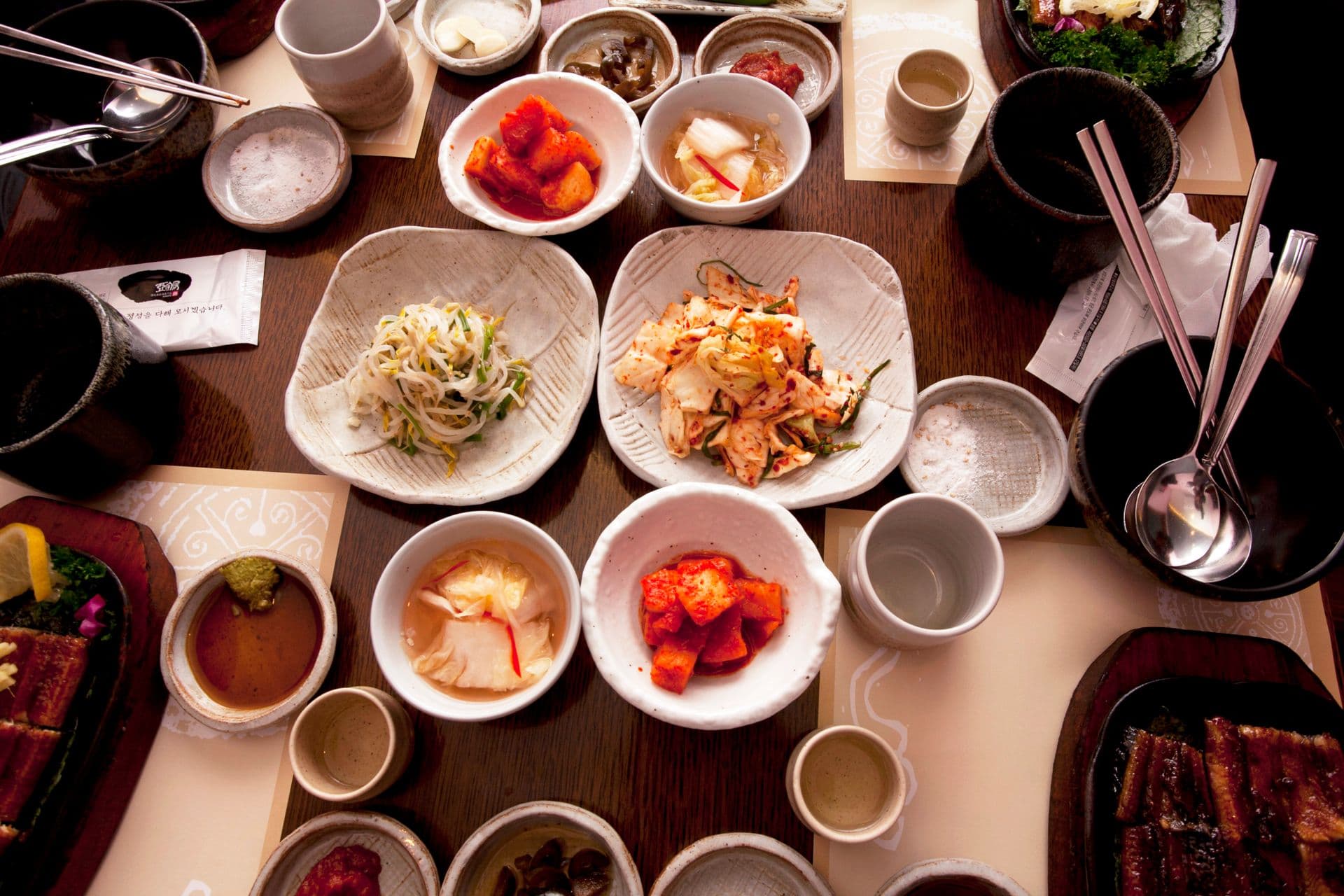
The moment that converts people to Korean food is rarely the main dish. It is the ambush that precedes it: a server covering the entire table in small plates nobody ordered — spinach glossed in sesame oil, cubes of fermented radish, a cold pancake, braised black beans, three kinds of kimchi. First-timers reliably ask the same two questions. Did we order this? And do we pay for it?
No, and no. That is banchan — and understanding it is understanding how Korean meals actually work.
So what is banchan, structurally?
Banchan are small shared side dishes served alongside rice — and the word "alongside" is doing precise work. Per the standard definition, banchan are not appetizers that precede a meal and not sides that support a protein, Western-style. They are co-equal components of a system: rice at the center, soup beside it, banchan arrayed in the middle of the table for everyone to share. The eating rhythm is the point — a bite of rice, a bite of something spicy, something cool, something crunchy, back to rice. Every mouthful is a different combination, which is why a Korean meal with four dishes never feels repetitive.
Formality scales the count. An everyday home table might carry three or four banchan; celebration tables and traditional full-course settings multiply from there. The old royal table settings codified this — more dishes signaled more honor to the guest.
The system even has numbers. A traditional table setting, the bansang, starts from rice, soup, a sauce, jjigae and kimchi, and is named by how many banchan are added on top: 3 cheop, 5 cheop, 7, 9, and 12 cheop — the last reserved for royal cuisine. Kimchi is never counted in the cheop total; it is assumed. Jeolla Province is still known for putting more varieties on a single table than anywhere else in the country.
Why Korea eats this way
The usual explanation goes back more than a thousand years. Buddhism, and the ban on eating meat that the Three Kingdoms-era monarchies imposed with it, pushed vegetable dishes to the centre of the table. Court kitchens developed elaborate ways to prepare them, commoners made smaller and simpler spreads, and by the time the Mongol invasions ended the ban, roughly six centuries of vegetable-based eating had shaped the cuisine for good.
Fermentation did the rest. Cooking oil was in short supply in Korea, so pickling in salt, soy, doenjang and gochujang became how vegetables survived hard winters and hot summers. That is why so much of a banchan spread is fermented or preserved, and why it is seasoned mainly with fermented soy products and sesame or perilla oil.
The main banchan families to recognize
Kimchi — fermented vegetables, most famously napa cabbage; the one non-negotiable presence at any Korean table. Namul — seasoned vegetables, blanched or sautéed and dressed with sesame oil, garlic, and soy; the spinach and bean sprouts you will meet everywhere, and the same namul that forms the heart of a bibimbap bowl. Jorim — ingredients braised down in soy or gochujang until glazed, like sweet soy braised black beans or potatoes. Jeon — savory pan-fried fritters and pancakes. Bokkeum — stir-fried items, from anchovies candied with syrup to fish cake ribbons. Jangajji — vegetables pickled in soy or brine. Learn those six words and no Korean restaurant menu will surprise you again.
Put names to them and a typical spread reads like this: kkakdugi (cubed radish kimchi) and oi sobagi (stuffed cucumber kimchi); gamja jorim (soy-braised potatoes) and jangjorim (beef braised in soy); myeolchi bokkeum (stir-fried dried anchovies) and eomuk bokkeum (stir-fried fish cake); manul jangajji (pickled garlic); dubu jorim (simmered tofu) and dubu gyeran jjim (tofu and egg custard). As one Korea Times column put it, many of these are versatile enough to become a light meal on their own — and the full-table version, hanjeongsik, is exactly that: banchan as the meal itself.
The etiquette — and the magic refill rule
Banchan are communal: chopsticks reach in from every seat, no serving spoons required among family and friends. Portions are small by design, meant to be finished — and in restaurants, most banchan are refillable on request at no charge. Koreans treat that refill as a right, not a favor. The polite move as a guest is simply not to demolish a single dish solo before others have had it; beyond that, reach freely. Nothing on the table is decoration.
Daniel's Bite
Banchan is the most quietly radical part of Korean dining and the least exported one — restaurants abroad trim it to two sad dishes because the economics of free, refillable, labor-intensive sides are brutal outside Korea. So here is my honest metric: judge any Korean restaurant overseas by its banchan spread before anything else on the menu arrives. A kitchen that ferments its own kimchi and rotates namul seasonally cares; a kitchen serving two-week-old bean sprouts from a tub will cut corners elsewhere too. My prediction: banchan-style eating — many small vegetable dishes, shared, built around rice — will keep gaining ground abroad simply because it is the most sustainable everyday-vegetable delivery system any cuisine has produced.
What to try next
- Start a home banchan rotation with three keepers: seasoned spinach, soy-braised black beans, and quick cucumber pickle.
- Watch how banchan interacts with grilled meat at a KBBQ table — it is the supporting cast that makes the format work.
- Next Korean restaurant visit, ask for a kimchi refill — enjoy how unremarkable the request is.
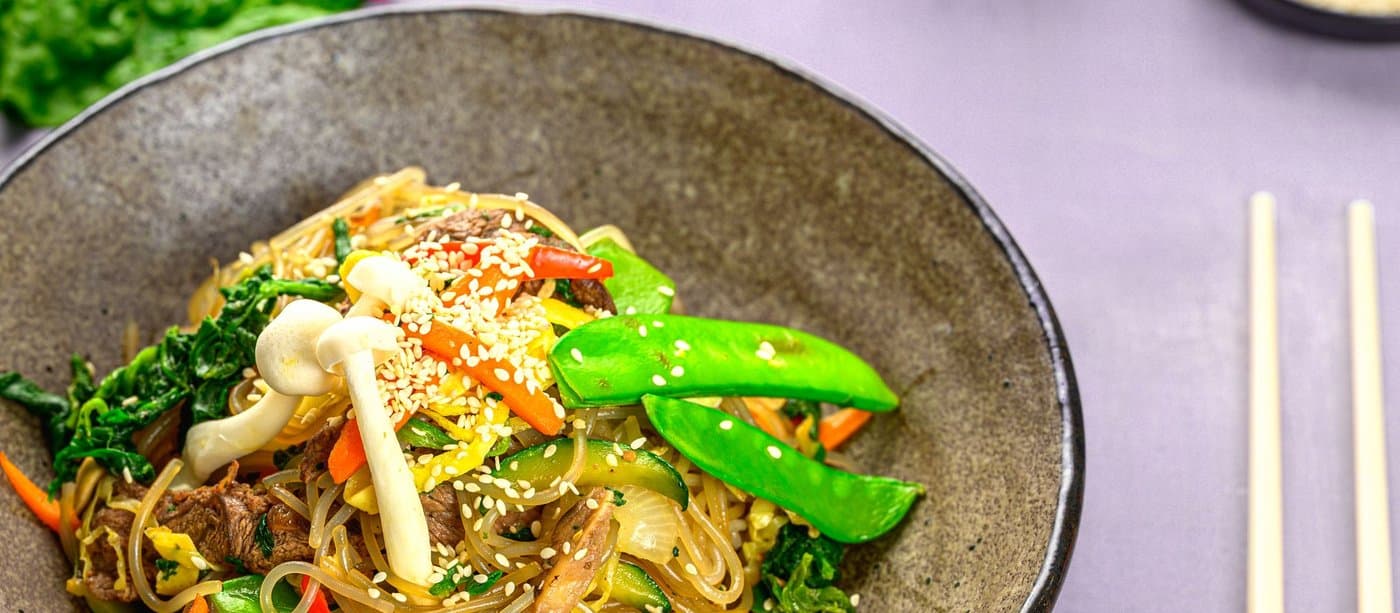
- Japchae sits at the edge of the category — big enough to anchor a holiday table, passed around the same family-style way. Our japchae recipe follows the five-separate-stir-fries method.
Banchan FAQ
Is banchan free in Korean restaurants?
Yes. Banchan come with the meal, and most are refilled on request at no extra charge.
How many banchan are served at a Korean meal?
It depends on formality. Home meals often have three or four; traditional settings are counted as 3, 5, 7, 9 or 12 cheop, with 12 reserved for royal cuisine. Kimchi is not counted.
Is kimchi a banchan?
Yes — the most common one, and the only one on nearly every Korean table.
Are banchan appetizers?
No. They are eaten alongside rice throughout the meal, not before it.
Can you ask for more banchan?
Yes. Portions are small so they can be finished and replenished during the meal; asking for a refill is completely normal.
How do you pronounce banchan?
BAHN-chahn.
Sources
- Banchan — Korean eating paradise — The Korea Times
- Banchan — categories and serving conventions — Wikipedia