The first thing that recalibrates a visitor's brain in Seoul is not a palace or a skyline — it is the steam. Steam off a vat of red tteokbokki, steam rising from an odeng cart on a cold night, steam escaping a just-pressed fish-shaped pastry. Korean street food is a complete parallel cuisine with its own venues (the tarp-covered pojangmacha stalls), its own seasons, and its own canon. Here is that canon, in the rough order you should eat it.
The core four of korean street food
1. Tteokbokki. Chewy rice cake cylinders in a gochujang sauce that is spicy, sweet, and communal — vendors stir enormous shared vats and serve it in cups, though it is straightforward enough to make at home. It is the default answer to "what should I try first."
2. Odeng (eomuk). Fish cake skewers bobbing in a shared broth. In winter, per The Korea Times' winter street food guide, the steam around an odeng cart is one of the most comforting sights in Korean city life — and each skewer comes with a small paper cup of the hot, slightly peppery broth. The two names are not interchangeable in origin: eomuk is the Korean word, odeng comes from the Japanese oden. Fish cake factories arrived with the colonial period, largely in port cities, and Busan is still the centre of Korea's fish cake industry.
3. Hotteok. A yeasted pancake stuffed with brown sugar, cinnamon, and crushed peanuts, pressed flat on a griddle until the filling turns molten. Officially a winter food; practically, sold year-round because demand never leaves. The name gives away its roots: ho was a historical Korean word for people from Central Asia and the Arab world, and the Korea Heritage Service traces it to rice cakes carried along the Silk Road through China. The usual account credits Chinese merchants who settled in Joseon in the late 19th century with spreading it. In Busan, the seed-filled version dates from the Korean War, when refugees started adding grains to the filling.
4. Bungeoppang. The fish-shaped waffle cake filled with sweet red bean paste, pressed in cast-iron molds. It is Korea's defining winter street snack, and its arrival on corners is treated as the true start of winter. It descends from Japan's sea bream-shaped taiyaki, came to Korea during the colonial period, became a carp, and spread once wheat flour was widely available after the Korean War — a cheap snack for factory workers through the 1960s and '70s. It is also getting harder to find. The long-standing street price of three for 2,000 won has given way to 1,000 won apiece in parts of downtown Seoul, rising costs have thinned out the vendors, and the shortage now has its own word — bungsegwon, the "bungeoppang zone" — plus crowd-sourced maps of where carts are still operating.
The market tier — go to Gwangjang
5. Bindaetteok. A mung bean pancake fried in generous oil until the edges shatter. It is the signature dish of Gwangjang Market, which was established in 1905 as the first permanent market in Korea to open daily. (Seoul's oldest market is Namdaemun, dating to around the 1400s — worth a detour for its hotteok queues.)
6. Mayak gimbap. Gwangjang's other famous export: mini seaweed rice rolls served with a mustard dipping sauce. The nickname means "narcotic gimbap," a joke about how they disappear by the plateful — the full-size version is a different animal entirely.
7. Sundae. Korean blood sausage stuffed with glass noodles, usually sold beside tteokbokki so you can dip one in the other's sauce — the veteran move.
The dessert-and-dare tier
8. Twigim. Korean tempura — battered vegetables, dumplings, and squid, sold by the piece and also destined for tteokbokki sauce.
9. Gyeranppang. Egg bread: a small sweet loaf with a whole egg baked into the top. Winter cart food, breakfast-adjacent, weirdly perfect. It is younger than it tastes: the version everyone copies is credited to a small shop near Inha University in Incheon in 1984, whose owner sold red bean bread and swapped the filling for an egg to serve customers who did not eat red bean.
10. Dakkochi. Grilled chicken skewers lacquered in sweet-spicy glaze, the smell of which does most of the selling.
Where to eat it — and the stall itself
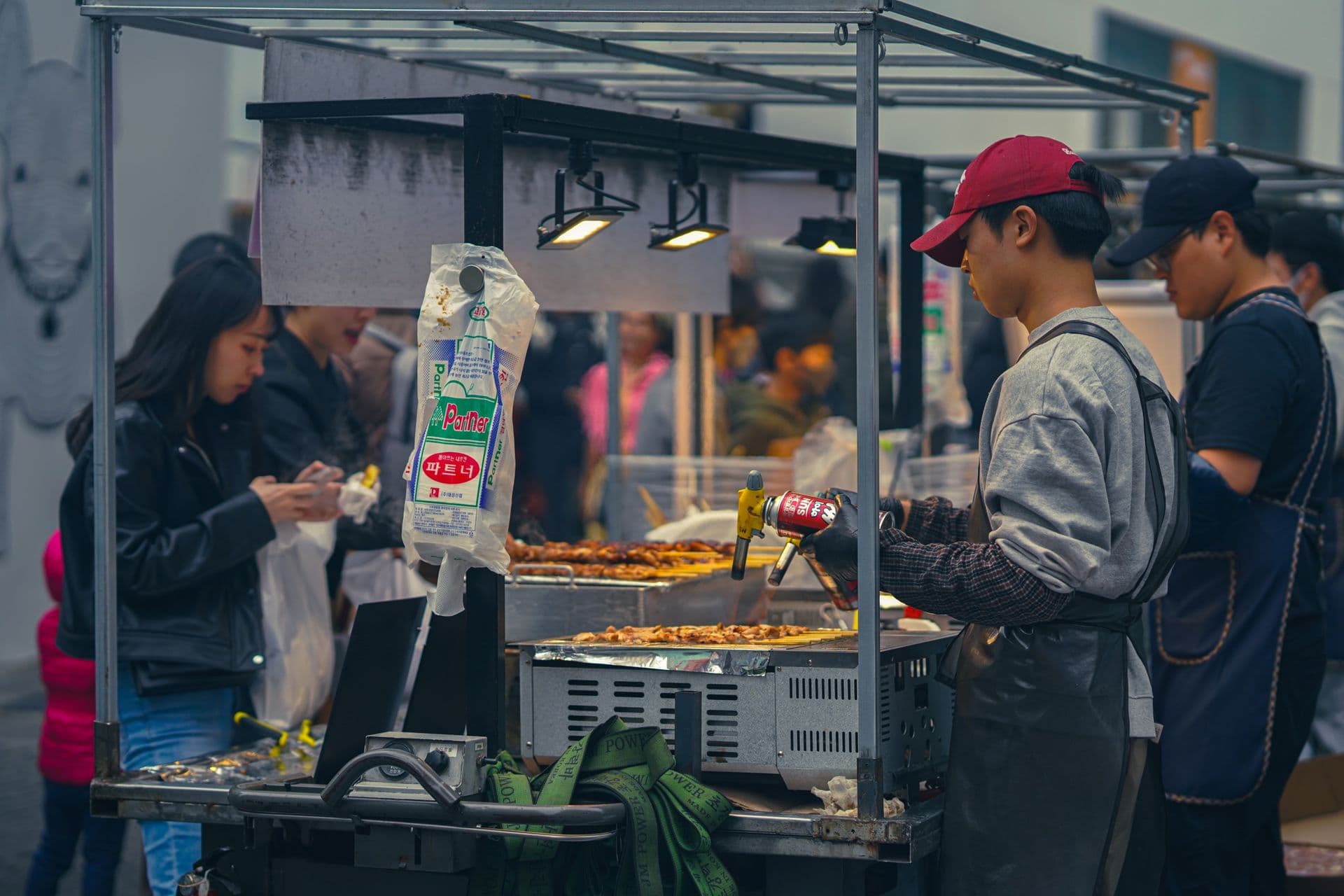
Much of this is sold from a pojangmacha, literally "covered wagon": a tented stall, sometimes on wheels, selling tteokbokki, sundae, odeng, dakkochi and anju, and often soju after dark. They are fewer every year, as complaints about hygiene and permits have pushed many off the street. For concentrated eating, Sindang-dong's Tteokbokki Town in central Seoul keeps the old outdoor-booth format alive, Myeong-dong has around 200 stalls — about half of them food — and Busan's Kkangtong Market was the first permanent night market in the country.
Daniel's Bite
The tourist mistake is treating street food as a Myeongdong photo op, where prices float highest and turnover skews to visitors. The better play is any subway exit near a university around 9pm, or a proper market like Gwangjang, where a stall's survival depends on regulars. My slightly contrarian ranking note: hotteok over bungeoppang, and it is not close — molten brown sugar beats red bean for a first-timer, and I will die on this hill despite the bungeoppang lobby. My prediction: whatever you plan to spend at a street market, you will spend more, because the format is engineered around "one more thing." Bring cash; the smallest carts still prefer it.
What to try next
- Time a Korea trip for winter if street food is a priority — the winter-only snacks are the best ones.
- Do the Gwangjang run: bindaetteok, then mayak gimbap, then argue about a third thing.
- Recreate the cart experience at home starting with street-style rice cakes and odeng broth.
Korean street food FAQ
What is the most popular Korean street food?
Tteokbokki, eomuk (fish cake skewers) and bungeoppang are the traditional core, with hotteok close behind.
What is the difference between eomuk and odeng?
Same food, two words: eomuk is Korean, odeng comes from the Japanese oden.
What is inside bungeoppang?
Traditionally sweet red bean paste. Custard cream is now standard, and cafés fill it with everything from sweet potato to pizza toppings.
What is a pojangmacha?
A tented street stall — the name means "covered wagon" — selling snacks and, in the evening, often soju.
Is Korean street food cheap?
Mostly, though prices are rising: bungeoppang that long sold at three for 2,000 won now costs 1,000 won each at some downtown Seoul carts.
Is street food available all year?
The core items are, but the traditional street snacks are most common in winter; in summer, ice cream takes over.
Correction, September 21, 2026: an earlier version attributed the Qing-merchant origin of hotteok to the Korea Heritage Service. The Heritage Service's account is Silk Road rice cakes arriving through China; the merchant story is the commonly cited one.
Sources
- Ultimate guide to Seoul's winter street food — The Korea Times
- Street food in South Korea — Wikipedia