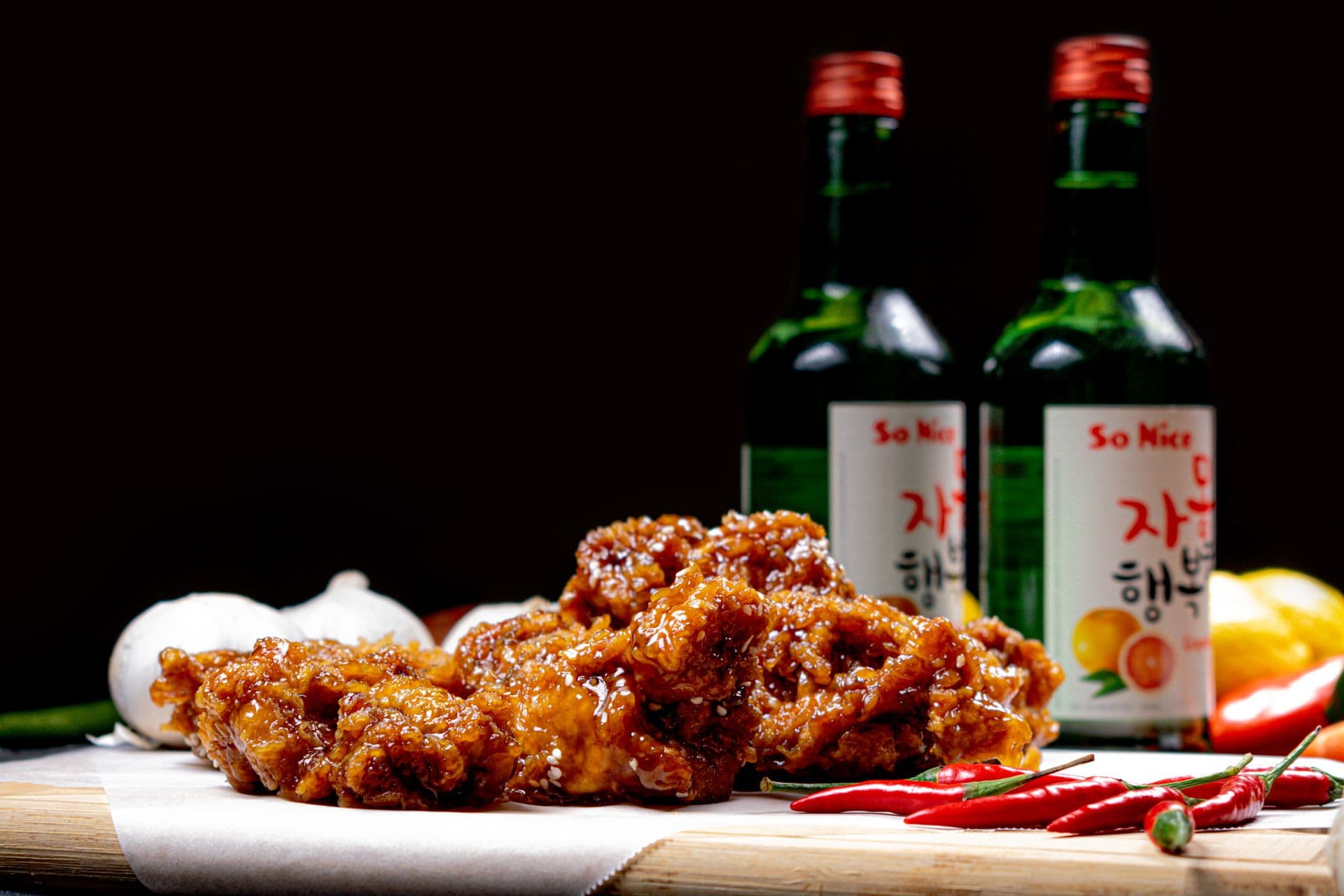
"It took me three years to perfect this recipe," Maangchi writes about her yangnyeom-tongdak — the sweet, sour, and spicy classic that most people abroad simply call Korean fried chicken. Three years, for fried chicken. Once you understand what the dish is doing, the obsession makes sense: it is chicken that stays audibly crunchy underneath a wet, sticky sauce. Regular fried chicken goes soggy in minutes under that treatment. This does not.
The entire trick behind any real Korean fried chicken recipe fits in two words: fry twice.
The double fry that defines the Korean fried chicken recipe
Per Maangchi's recipe, updated March 2025: the first fry, at 330 to 350°F for about 12 minutes, cooks the chicken through. Drain it, let it rest, then fry again at the same temperature range for roughly another 12 minutes. The first pass cooks; the second pass drives out moisture and builds the light, airy crust that survives saucing. Her coating is also deliberately un-Southern: half a cup of potato starch to a quarter cup of flour, plus baking soda and egg. Starch, not flour, is what shatters instead of crunching heavily.
The practical details: 2 inches of oil in a large, heavy pan, heated for 10 to 12 minutes to reach 330–350°F. No thermometer? Dip one piece of chicken in — if the oil bubbles around it, it is ready. The coating is mixed straight onto the wings by hand in one bowl — salt, pepper, starch, flour, baking soda, eggs — and the pieces go into the oil one by one, in batches if your pan is smaller than 12 inches. Between fries they drain on a wire strainer, and the oil gets 2 minutes to climb back to temperature before the second round.
The yangnyeom sauce is four pantry items
Yangnyeom means "seasoned," and the iconic red glaze is less exotic than its color suggests: a third of a cup of ketchup, a third of a cup of rice syrup, a quarter cup of gochujang, 2 teaspoons of vinegar, plus garlic bloomed in oil. Simmer until bubbling, then toss the hot, twice-fried chicken through it. That is the entire mystique. The ketchup is not a Western shortcut — it is standard in Korean home versions, bringing tomato acidity that balances the fermented heat of the gochujang.
How Korea became a fried chicken country
Yangnyeom chicken is younger than most people assume. Per the history of Korean fried chicken, deep-fried chicken arrived with the U.S. military presence after the Korean War, but modern fried chicken only took off in the 1970s, once cooking oil became widely available. The first franchise, Lims Chicken, opened in 1977 in the basement of the Shinsegae department store in Seoul. The sauce came in 1982: Yun Jonggye, running a chicken shop in Daegu, noticed customers struggling with hard, crisp crusts that scraped their palates, and started coating the chicken in a sweet-spicy glaze to soften the bite. KFC opened in Korea two years later.
Maangchi remembers that era from the customer side — yangnyeom-tongdak arriving at her door in under an hour, from franchises that all tasted similar, where the only real difference between one shop and the next came down to two things: the batter and the sauce. Her recipe came from watching a neighbour who ran the local shop make both in front of her.
The scale since then is hard to overstate. The Asian financial crisis of the late 1990s sent laid-off workers into opening chicken shops; by 2017 there were 36,000 fried chicken restaurants in South Korea, and 40,000 as of 2026, with another 1,800 run by Korean brands in 60 countries.
Chimaek culture — how Korea eats this chicken
In Korea this is not dinner, it is an event. Fried chicken plus beer has its own portmanteau — chimaek, from "chikin" and "maekju" — and its own rituals: delivered late, eaten communally, paired with cold lager and cubes of pickled radish called chicken-mu that reset your palate between pieces. Maangchi's serving note says 2 pounds of wings feeds 3 to 4 people, which any Korean will tell you is optimistic math once the beer opens. It is also why chimaek turns up in nearly every K-drama.
One practical warning before you start: the rice syrup and ketchup in the glaze scorch quickly, so the sauce gets made in its own pan, off to the side, and only meets the chicken at the very end. Toss, do not simmer — the crust you spent two fries building dissolves if it sits in wet sauce over heat.
Daniel's Bite
Living in Seoul, I order chimaek probably twice a month, and here is the thing the delivery apps have taught me: the famous chains coast. The double-fry technique is standard everywhere now, so the differentiator is sauce freshness — chains pre-batch it, and you can taste the age. Which is why homemade beats delivery on this dish more decisively than almost any other Korean food. It is also why I think the yangnyeom style, not plain huraideu, is the version worth learning first: the sauce hides small frying mistakes while you practice. My prediction: your second attempt will beat your local Korean fried chicken takeout. The first attempt — respect the 12-minute fry times and do not crowd the oil — call it a training run.
What to try next
- Make chicken-mu or buy a jar — the pickled radish cubes are non-negotiable at Korean chicken houses.
- Split the batch: toss half in yangnyeom sauce, leave half plain, and serve both like the "half-half" order Koreans default to.
- Cold beer, no exceptions — this dish was engineered for chimaek, and the table etiquette comes with it.
Korean fried chicken FAQ
Why is Korean fried chicken fried twice?
The first fry cooks the chicken through; the second drives out moisture and builds a light, crisp crust that stays crunchy under sauce.
What is the difference between huraideu and yangnyeom chicken?
Huraideu is plain fried chicken with no sauce added after frying. Yangnyeom chicken is coated in a sweet, spicy gochujang-based glaze. Ordering half of each is common enough to have its own name: banban.
What other Korean fried chicken styles are there?
Ganjang chicken is glazed in a sweet, often garlicky soy sauce; padak comes buried in shredded scallions; tongdak is the old-style whole fried chicken; sunsal chicken is boneless.
Do I have to drink beer with it?
No. Chimaek is the classic pairing, but Maangchi herself drinks nonalcoholic beer with hers.
What is chicken-mu?
Cubes of pickled radish served on the side with fried chicken at Korean chicken shops.
How many people does 2 pounds of wings feed?
Three to four, per the recipe.