The dish Maangchi avoided for years is now one of the most requested recipes on her site. Budae-jjigae — army base stew — is kimchi, pork belly, Spam, Polish sausage and half a pack of ramyeon boiling together in one shallow pot, and if that ingredient list makes you skeptical, you are in good company: Maangchi herself admits the idea "never appealed" to her until years of reader requests wore her down. Her budae jjigae recipe, first posted in October 2014 and updated as recently as February 2024, now sits at 4.8 out of 5 from 374 votes, and the video behind it has been watched over 4.5 million times. The converts have a point.
A stew invented from an army base's leftovers
Budae-jjigae dates to the years after the Korean War (1950–1953), when American troops were stationed in Uijeongbu, just north of Seoul. The base had canned goods Koreans had never cooked with — Spam, ham, sausages, baked beans. When those ingredients made their way into the surrounding neighborhoods, local cooks did the most Korean thing possible: boiled them with kimchi, garlic, gochujang and gochugaru into a communal stew. One of its old nicknames is Jonseun-tang — "Johnson soup," after the U.S. president. The dish is a history lesson you can eat, which is part of why it never left the menu even after Korea got rich.
The fuller history is darker than the name suggests. Its predecessor, kkulkkuri-juk — "piggy porridge" — came out of the extreme poverty of the war years, and Spam, now the ingredient most people picture, was only legally sold in South Korea from 1987. Uijeongbu, which claims to have made the dish first, now has a whole Budae-jjigae Street of specialist restaurants, and the Nolboo chain has run more than a thousand locations nationwide. The Johnson soup is its own variant: developed in Seoul's Yongsan District and named after Lyndon B. Johnson, who is said to have eaten it during his 1966 visit. It swaps kimchi for plain napa cabbage, skips the ramyeon, includes cheese by default and arrives already cooked — and Bada Sikdang, the restaurant where he ate it, still serves it. Regional styles split too: Uijeongbu's uses barley-based gochujang for a thicker, spicier broth, while Songtan's leans on napa cabbage.
The stock is the whole argument of this budae jjigae recipe
Everything about budae-jjigae looks like a dump-and-boil dish, and that is exactly the trap. Per Maangchi's recipe, the base is a proper stock: 8 large dried anchovies with heads and guts removed, a 5-by-6-inch sheet of dried kelp, 2 dried shiitake mushrooms and 8 cups of water, covered and simmered for 25 minutes — then the pork belly cooks in that same stock for another 10 minutes before anything else happens. If you have made our kimchi jjigae, the logic is familiar, just scaled up: that stew uses 7 anchovies in 4 cups of water for 20 minutes, while budae-jjigae doubles the volume to 8 cups. The reason is the table itself — this stew keeps boiling on a burner while everyone eats, the broth cooks down, and you top it up as you go. Water cannot survive that treatment. Stock can. Maangchi's other insistence is that everything should be mostly cooked before the pot is assembled — the pork gets its 10 minutes in the stock precisely so you never have to wonder whether it is done. Strain it and you get about 6 cups, seasoned with a teaspoon of salt; 3 go into the pot, and the rest is your top-up supply.
Layering, not stirring
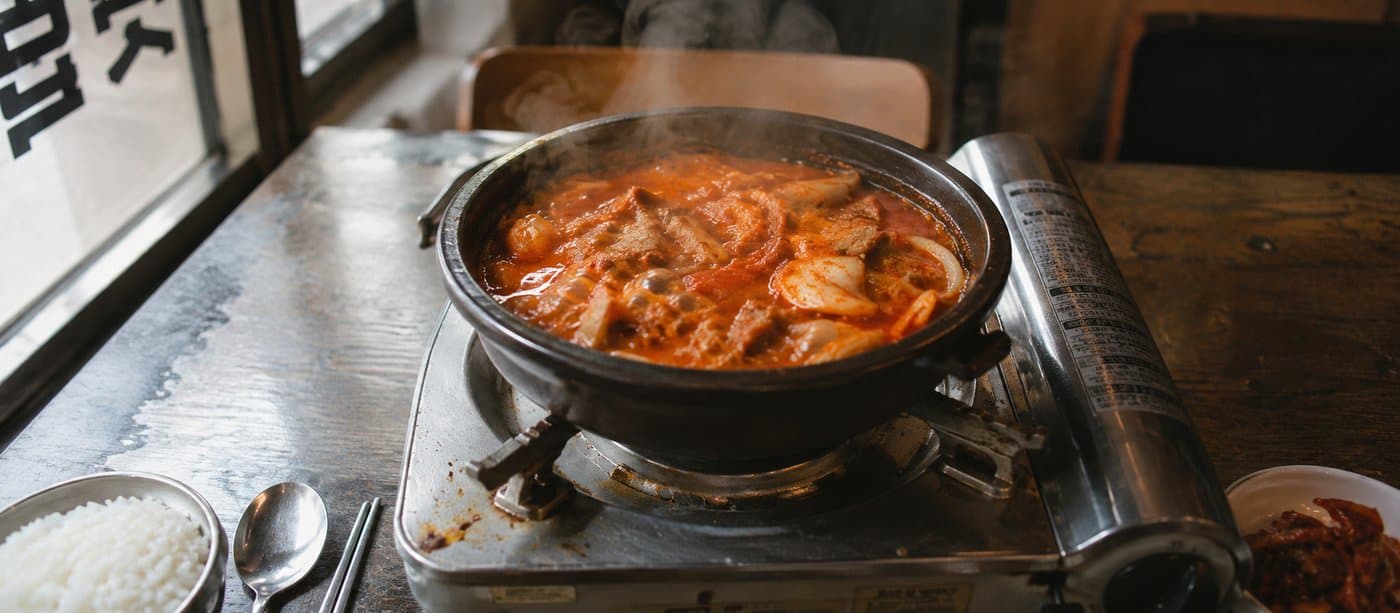
The assembly is closer to arranging than cooking. Cabbage, onion, green onion, the cooked pork and sliced shiitake go on the bottom of a shallow 10-to-12-inch pot. Then half a cup of chopped fermented kimchi and the seasoning paste — 6 minced garlic cloves, 1 tablespoon of gochujang, 2 tablespoons of gochugaru, a teaspoon each of soy sauce and sugar, loosened with water. On top: 4 ounces of thinly sliced Spam, 4 ounces of Polish sausage, and the optional layer where families fight — tofu, baked beans, sliced rice cakes, one slice of American cheese. The ramyeon and soaked sweet potato starch noodles crown the pot, 3 cups of stock go over everything, and about 10 minutes on medium-high gets it to a rolling boil. Korean style is to cook it at the table and start pulling sausage with your chopsticks before the noodles even soften. Two finishing touches from the recipe: a cup of radish sprouts on top (spinach, watercress or arugula work too), and a stir with tongs once it boils so everything cooks evenly. The sweet potato noodles need 30 minutes of soaking beforehand, and the stew is ready the moment the ramyeon softens — serve it hot and bubbling, never lukewarm.
Daniel's Bite
Growing up in LA I thought Spam was a pantry punchline; in Seoul it comes in department-store gift sets, and budae-jjigae is why. My position on the optional layer: the American cheese stays, the baked beans go. The cheese melts into the broth and rounds out the gochujang burn — it is the one place in Korean cooking where a processed single earns its spot. Beans just make the pot sweeter and muddier, and Maangchi lists them as optional for a reason. My prediction: cook this once with the 25-minute stock and once with plain water on back-to-back weekends. If anyone at your table asks for the water version again, I owe you a can of Spam.
What to try next
- Reuse the anchovy-kelp stock logic in kimchi jjigae — smaller pot, same backbone, 20 minutes instead of 25.
- Leftover gochujang and gochugaru from the seasoning paste? That is most of the way to tteokbokki.
- Track how your broth level drops at the table — the top-up-as-you-go rhythm is the same skill you need for Korean BBQ at home.
Budae jjigae FAQ
What does budae jjigae mean?
"Army base stew" — budae refers to a military base, jjigae to a stew.
Why is there Spam in budae jjigae?
The dish grew out of canned American foods — Spam, ham, sausages, baked beans — that reached Korean kitchens from around the U.S. base in Uijeongbu after the Korean War.
Does budae jjigae have cheese?
Often: a single slice of American cheese is a common, optional topping, and the Johnson-tang variant includes it by default.
Which ingredients are optional?
Per Maangchi: tofu, baked beans, rice cakes, cheese and radish sprouts.
Can I make budae jjigae with water instead of stock?
You can, but the anchovy-kelp stock is what makes it; Maangchi calls it irreplaceable.
How many people does it serve?
This recipe serves four, with extra stock to top up the pot as it boils down.
Sources
- Budae-jjigae (Spicy sausage stew) — Maangchi
- Budae-jjigae — origins and ingredients — Wikipedia