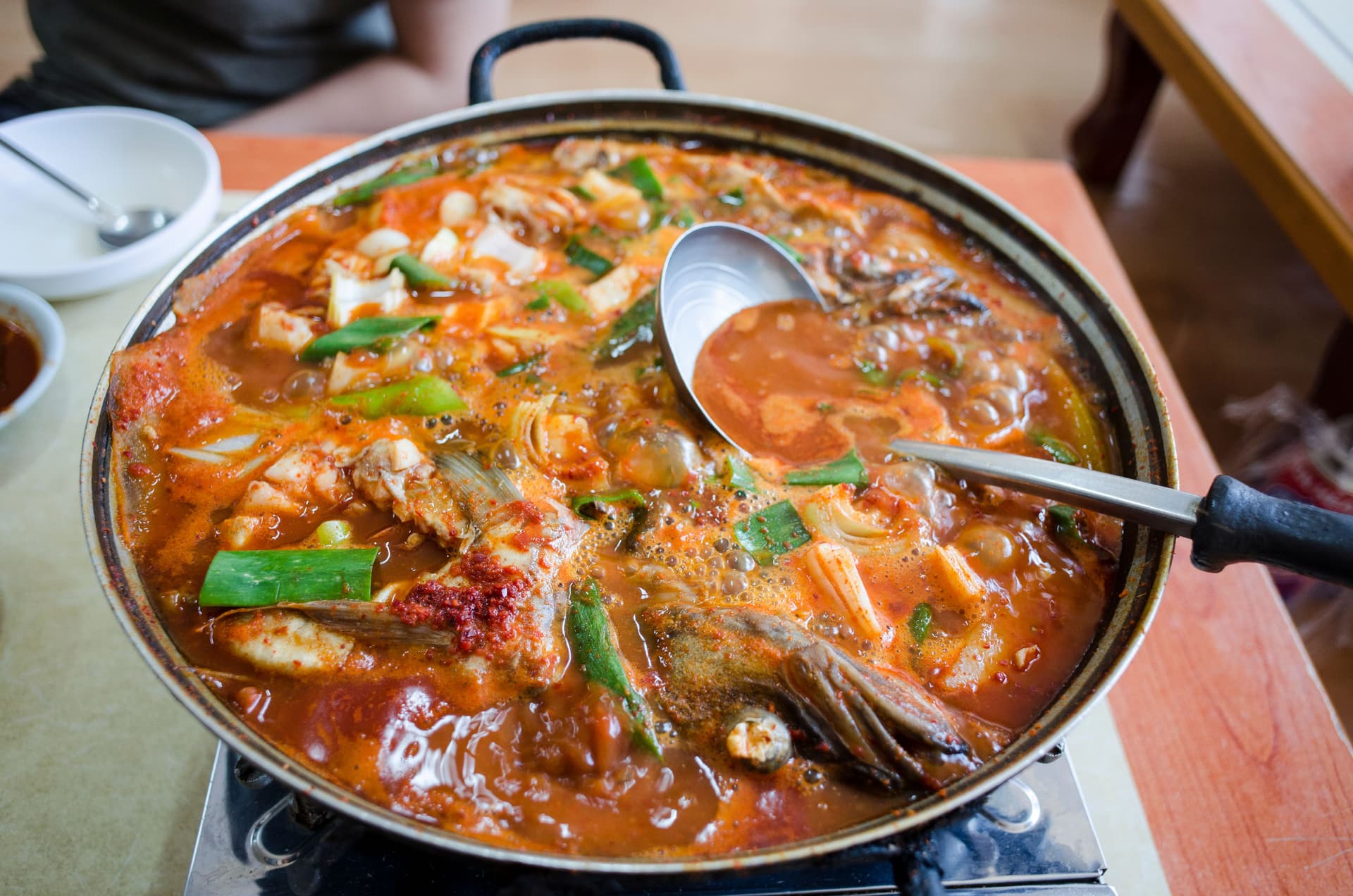
The best kimchi jjigae I ever ate came from a restaurant with exactly one item on the menu — and the kimchi jjigae recipe below is built on that restaurant's trick. Maangchi — the New York-based Korean cooking teacher whose kimchi jjigae video has been watched over 6.6 million times on YouTube — tells the same story: she learned her method from a single-dish restaurant in Korea where the stew arrived at the table raw and finished cooking over a burner while everyone watched. No secrets possible. Kimchi, pork, onion, seasonings — and a broth base that turned out to matter more than anything else.
If you have been making this kimchi jjigae recipe with plain water and wondering why it tastes flat compared to the restaurant version, that broth is your answer.
Why anchovy stock is the whole game in this kimchi jjigae recipe
Maangchi published her original kimchi stew recipe back in November 2007, then revised it years later around one change: a savory anchovy stock instead of water. Per her recipe, you boil 7 large dried anchovies (heads and guts removed), a 4×5-inch piece of dried kelp, a third of a cup of thinly sliced Korean radish, and 3 green onion roots in 4 cups of water for 20 minutes over medium-high heat, drop to low for another 5, then strain. You end up with about 2½ cups — enough for the stew with a little left over. That is 25 minutes of mostly hands-off time that converts a decent stew into the version people sweat over in Seoul.
The rest of the build is simple: 1 pound of well-fermented kimchi cut into bite-size pieces, a quarter cup of kimchi brine straight from the jar, half a pound of pork shoulder or pork belly, sliced onion, 1 tablespoon of gochujang, 2 teaspoons of gochugaru, a teaspoon each of salt and sesame oil, 2 teaspoons of sugar. Cover with 2 cups of the stock, cook 10 minutes over medium-high, add tofu on top, then another 10 to 15 minutes over medium.
The order matters more than it looks. Everything except the tofu and the last green onion goes into a shallow pot at once — kimchi and brine on the bottom, pork and onion on top, seasonings and a drizzle of sesame oil over everything, stock poured in last. You only open the lid and stir after the first 10 minutes of cooking. No anchovies in the cupboard? The recipe allows chicken or beef broth as a substitute. It will be good. It will not be the restaurant version.
Old, sour kimchi beats fresh kimchi here
This is the dish that justifies making kimchi in bulk. Freshly made kimchi has crunch but not much depth; kimchi that has fermented past its crisp prime — the jar you almost gave up on — brings acidity and funk that the pork fat rounds out. The quarter cup of brine is not optional garnish, it is seasoning. Maangchi herself has pointed out to readers that this is exactly why Koreans make so much kimchi: not just as a side dish but as an ingredient for dishes like this.
Stew, not soup — how kimchi jjigae differs from kimchi-guk
Korean cuisine draws a real line between guk (soup) and jjigae (stew). Per Maangchi's notes, kimchi jjigae is thicker and saltier than kimchi soup, and traditionally lands in the middle of the table as one communal pot, everyone reaching in with their own spoon — though these days plenty of families ladle it into individual bowls first. The recipe serves 2 with side dishes or 4 without, which tells you how Koreans actually eat it: as the salty, spicy anchor of a table crowded with rice and banchan.
Where kimchi jjigae goes wrong
- Plain water as the base. Maangchi's own recipe served her for years on water — the single-dish restaurant used water too — and she still rebuilt it around anchovy stock. If the stew tastes thin, this is the first thing to change.
- Fresh kimchi. Kimchi's flavour as an ingredient gets stronger and more complex as it ages, which is why older, more fermented kimchi is the standard choice for stew. Crisp new kimchi gives you a clean, one-note pot.
- Throwing away the brine. The quarter cup from the jar is where the sourness lives.
- Tofu in too early. It goes on top after the first 10 minutes and the first stir, not at the start.
- Cooking it for the probiotics. Aged kimchi does carry more live bacteria — but they do not survive the boil. Make kimchi jjigae for the flavour; eat kimchi raw on the side if gut health is the goal.
Tuna, saury and other versions worth knowing
Pork is the default, not the only option. Chamchi kimchi jjigae swaps the pork for canned tuna and is a camping favourite. Kkongchi kimchi jjigae is made with Pacific saury. Mushroom-and-vegetable versions work as a vegan pot if you also skip the anchovies. And the stew that starts from kimchi and adds Spam, hot dogs and a slice of American cheese has its own name and its own origin story in the Korean War: budae jjigae.
The dish itself is younger than kimchi. Pickled vegetables existed in Korea long before the Joseon era, but the red, chilli-heavy kimchi this stew depends on only took shape after chilli peppers arrived in the middle of that period — and kimchi jjigae is thought to date from around the same time. In restaurants it still comes out the traditional way, boiling hot in a stone pot.
Daniel's Bite
I moved to Seoul in 2021 and this was the first dish I learned to cook properly, mostly out of financial self-defense — a pot of it costs a fraction of ordering in and feeds you for two days. My contrarian position: skip the tofu the first time you make it. Everyone treats tofu as mandatory, but it dilutes the broth-to-kimchi ratio while you are still calibrating. Get the stew right, then add tofu on round two. And do not buy pre-cut pork labeled "for jjigae" at a premium — pork shoulder trimmed at home is cheaper and identical. My prediction: if you make the anchovy stock once, you will never go back to the water version. If you do, I owe you a bowl.
What to try next
- Master the stock ratio — 7 anchovies, 4 cups water, 20 minutes — and reuse it for tteokbokki, which uses nearly the same base.
- Track how your kimchi jar changes week to week; jjigae is best from kimchi fermented at least a few weeks.
- Try the pork belly version against the pork shoulder version and pick a side — it is a genuine debate at Korean tables.
- Not sure which red pepper product does what? Our gochujang vs gochugaru guide explains why this recipe uses both.
Kimchi jjigae FAQ
Can I make kimchi jjigae with fresh kimchi?
You can, but it will taste flat. Older, well-fermented kimchi is the standard because its flavour gets stronger and more complex with age.
What is the difference between kimchi jjigae and kimchi soup?
Jjigae is a stew: thicker and saltier, and traditionally shared from one pot in the middle of the table. Kimchi-guk, the soup, is less salty and always served in individual bowls with rice.
What can I use instead of anchovy stock?
Chicken or beef broth. Plain water works, but it is the main reason homemade versions taste weaker than restaurant ones.
Which pork cut is best for kimchi jjigae?
Pork shoulder or pork belly — half a pound for this recipe.
Is kimchi jjigae still probiotic?
No. The live bacteria in kimchi do not survive being boiled, so the stew keeps the flavour of fermentation but not the probiotics.
How many people does this recipe serve?
Two as a main with rice and side dishes, or four without.
Sources
- Kimchi-jjigae (Kimchi stew) — Maangchi
- Kimchi-jjigae — regional variations — Wikipedia