Call kimbap "Korean sushi" in front of a Korean friend and watch their face do something complicated. Yes, it is rice rolled in seaweed. The resemblance ends almost immediately after that — and the differences are exactly what make a kimbap recipe worth learning separately, even if you already roll maki.
Start with the name: gim is the sheet of dried seaweed, bap is rice. Per Maangchi, whose classic gimbap recipe is the reference version for the dish, the definition is generous — as long as you can roll some rice in gim, you can say you made gimbap.
The rice is the real difference in any kimbap recipe
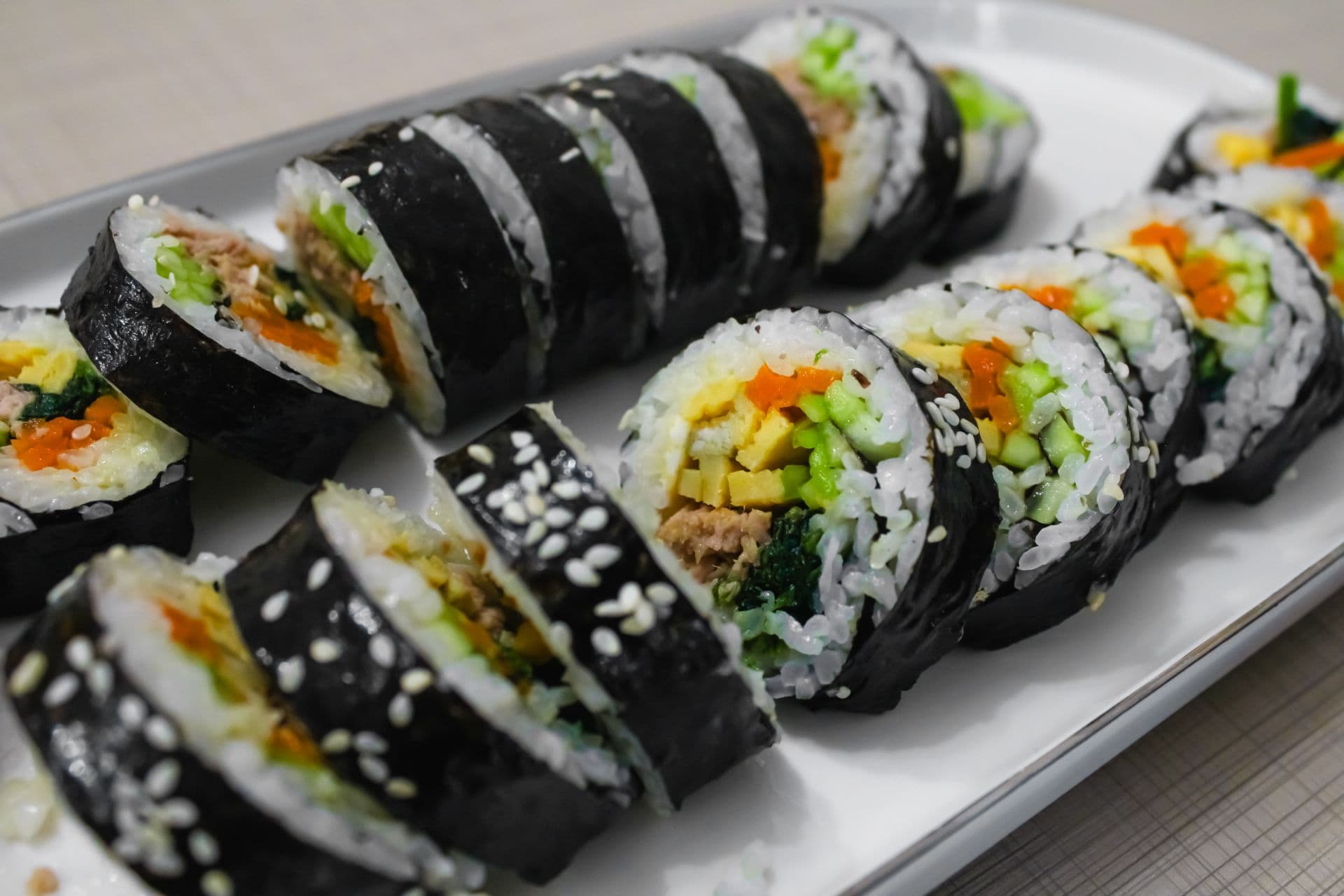
Sushi rice is seasoned with vinegar and sugar. Kimbap rice is seasoned with salt and toasted sesame oil — no vinegar anywhere. That single swap changes the entire flavor direction: nutty and savory instead of tangy. It also changes food safety logic; kimbap is a same-day food, made in the morning and eaten by afternoon, which is precisely its cultural job. Fillings are cooked or pickled, not raw fish: the classic set per Maangchi's recipe is seasoned beef, sautéed carrot, yellow pickled radish (danmuji), blanched seasoned spinach, and strips of thin egg omelet. Five colors, five textures, zero wasabi.
The quantities are gentle. Four cups of freshly cooked rice get half a teaspoon of salt and 2 teaspoons of sesame oil, mixed in lightly and left until they stop steaming. The carrot matchsticks sit in salt for 5 to 10 minutes, get squeezed, and see a hot pan for about a minute. The beef — skirt steak cut into quarter-inch strips — is marinated in soy sauce, garlic, black pepper, sugar and sesame oil, then cooked through. The egg is the one that takes patience: a thin sheet over low heat, flipped once, then left off the heat in the hot pan for about 5 minutes so it sets yellow instead of browning, and cut into half-inch strips.
Substitutions are built into the classic, too: salted cucumber sticks for spinach, imitation crab or sautéed red bell pepper for carrot, sausage or ham for beef — or, if you are in a hurry, just chopped kimchi.
Is kimbap really not sushi? The honest history
This is where the "not sushi" line needs a footnote. Gimbap's origins are debated. The commonly accepted theory is that it grew out of Japanese norimaki, introduced during the colonial period; the word gimbap first appears in a Korean newspaper in 1935, when norimaki was still used alongside it. The rolling-on-a-bamboo-mat-and-slicing technique is generally agreed to have come from Japan. The Academy of Korean Studies' encyclopedia points to an older Korean habit too — rice and side dishes wrapped in gim, recorded as bokssam in an 1819 book — though those are usually treated as precursors rather than the same dish.
What is not in dispute is that the two have gone separate ways. Gimbap is seasoned with sesame oil, makizushi with rice vinegar, and in Korea the Japanese roll is called by a different name altogether. So the sushi comparison is fair on ancestry and wrong on the dish in front of you.
Built for picnics, school trips, and teachers
Kimbap is Korea's lunchbox food, and the nostalgia around it is thick. Maangchi describes school picnic days when every kid arrived with rolls from home and traded bites to judge whose mother made it best — and moms sending an extra roll for the teacher as a thank-you, leaving teachers buried in gimbap they redistributed to kids who came without. The dish means someone packed this for you. That is a fundamentally different emotional register from sushi's restaurant-craft prestige.
Rolling technique — the two-inch rule
The mechanics, per the classic recipe: a sheet of gim shiny-side down on a bamboo mat, about three-quarters of a cup of cooked rice spread evenly, leaving 2 inches of bare seaweed at the far edge. Fillings go in a tight line at the center. Roll the near edge over the fillings first so they stay centered, then squeeze and advance, pushing the mat out as you go. Finish seam-down so it seals itself, brush the outside with sesame oil, sprinkle sesame seeds, and slice with a knife wiped between cuts. One batch — 5 rolls — serves 2 to 3 people. Expect your first roll to be ugly. Ugly kimbap tastes identical, and roll three is where the mat starts obeying you. If you would rather someone else did the rolling, the market stalls sell mayak gimbap by the plateful.
Daniel's Bite
I will say the quiet part: good kimbap is harder to make than decent maki, because there is no soy sauce bath at the end to rescue underseasoned rice — the roll has to be complete in itself. My firm opinion, shared with Maangchi, is that mayonnaise has no business inside a classic roll; if you want creamy, tuna-mayo is its own established variant, keep it there. And buy danmuji rather than substituting — that fluorescent yellow radish crunch is structurally load-bearing. My prediction: make kimbap once for another person and the reaction will out-earn dishes that took you three times the effort. It reads as care, not cooking.
What to try next
- Master classic, then branch: tuna gimbap, kimchi gimbap, or bulgogi gimbap using leftover Korean BBQ meat.
- Slice one roll unsliced into a lunchbox wrapped in foil — the authentic on-the-go format.
- Compare your roll to convenience-store triangle gimbap in Korea; the gap is the point.
Kimbap FAQ
What is the difference between kimbap and sushi?
Kimbap rice is seasoned with salt and sesame oil, sushi rice with vinegar and sugar. Kimbap fillings are cooked or pickled rather than raw fish.
Is it kimbap or gimbap?
Both. Gim (seaweed) plus bap (rice); "gimbap" follows the official Revised Romanization, and "kimbap" is the common alternative spelling.
How long does kimbap keep?
It is meant to be eaten the same day. One fix for day-old slices: coat them in beaten egg and pan-fry them.
What is chungmu gimbap?
A thin roll from Tongyeong (formerly Chungmu) with only rice inside, served with spicy squid salad and radish kimchi on the side.
What is triangle kimbap?
Samgak gimbap — a triangle of rice wrapped in gim, sold in Korean convenience stores with a one-day shelf life.
How many rolls does one batch make?
Five rolls, enough for 2 to 3 people.
Sources
- Gimbap (Seaweed rice rolls) — Maangchi
- Gimbap — how it differs from sushi — Wikipedia