There is a reason japchae shows up at every Korean gathering that matters — chuseok tables, birthdays, the potluck where someone's aunt is being judged. When readers ask Maangchi for one dish to bring to a party, she says she doesn't hesitate: japchae, "for the simple reason that pretty much everyone loves it." Her japchae recipe is one of the oldest things on her site — posted July 15, 2007 — and it is still one of the biggest: 4.5 out of 5 from 1,388 votes, with the video sitting at over 11.1 million YouTube views and 174,000 likes. For comparison, her budae-jjigae video, no slouch, has 4.5 million. Glass noodles win the internet.
One dish, five separate stir-fries
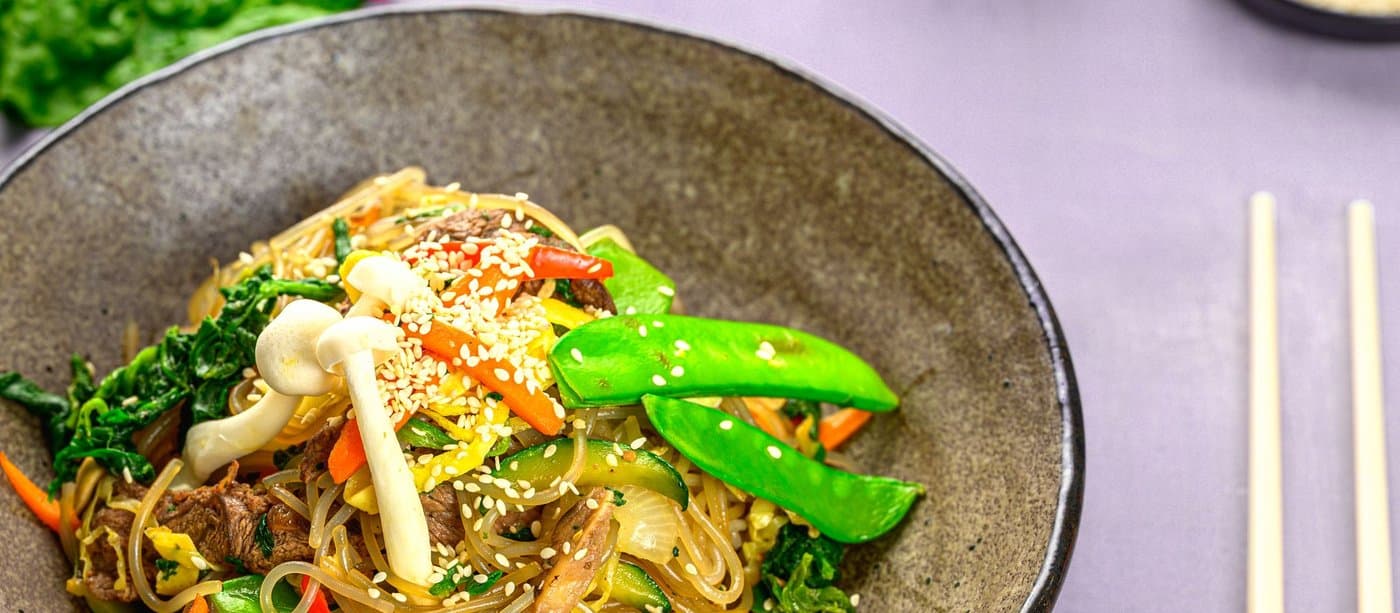
The thing that separates a real japchae recipe from the sad gray version is embarrassingly simple: every ingredient gets stir-fried separately. Onion and green onion together, about 2 minutes with a pinch of salt. White mushrooms, 2 minutes. Carrot matchsticks, 20 seconds, then red bell pepper for another 20. Marinated beef and soaked shiitake last, until the beef loses its pink. The beef can be filet mignon or pork shoulder, and the dried shiitake need 2 to 3 hours in warm water before they are sliced — the one step to start well ahead. Each round goes into the same big mixing bowl, but nothing cooks together. Maangchi is upfront that this "seems like a lot of labor," and her reason for doing it anyway is the whole dish: each ingredient needs a different cooking time, and keeping every color intact is what makes the final plate look the way it does. One-pan japchae is faster and it tastes fine. It also looks like something you are apologizing for.
The noodles are a recipe of their own
Dangmyeon — sweet potato starch noodles — are what make japchae japchae, and the recipe uses a restrained 4 ounces for four servings. They boil covered for 1 minute, get a stir so they don't stick, then cook another 7 minutes to that glassy chew. Straight out of the pot they get cut a few times with kitchen scissors and seasoned immediately — 2 teaspoons of toasted sesame oil, a teaspoon each of soy sauce and sugar — which both flavors them and stops them from welding into a brick. Maangchi's quiet pro move sits in the same paragraph: use more vegetables and fewer noodles, and the dish gets prettier and healthier at the same time. Even the egg garnish is its own micro-recipe — yolk only, cooked on residual heat for a minute per side so it stays bright yellow. The spinach, meanwhile, is blanched for 30 seconds to a minute in the same pot of water before the noodles go in, then squeezed dry and seasoned with a teaspoon each of soy sauce and sesame oil. Once everything is in the bowl, the final seasoning goes over all of it at once: a minced garlic clove, a tablespoon each of soy sauce and sugar, half a teaspoon of black pepper and 2 teaspoons of sesame oil, mixed by hand, then the egg strips and a tablespoon of sesame seeds.
A royal dish that started without noodles
The name means "mixed vegetables" — jap, mixed, and chae, vegetable — and for its first three centuries that is all it was. According to the Veritable Records of the Joseon Dynasty, japchae was created in the early 17th century by Yi Chung for a palace banquet held by King Gwanghaegun, who liked it enough to promote him to a post equivalent to Secretary of the Treasury. That japchae had no noodles and no meat — cucumbers, radishes and shiitake were among the vegetables — and it was a luxury reserved for the royal family and senior officials. The sweet potato noodles only arrived from China in the 20th century, and they have been the heart of the dish ever since.
That royal pedigree explains where japchae still turns up: weddings, holidays, a baby's first birthday (dol) and the 60th (hwangap). It also explains why it is such a good party dish — it can be served warm, at room temperature or cold, freshly made or the day after.
Side dish, not main — and that matters
Here is the thing English-language menus get wrong: japchae is filed under side dishes in Korean home cooking, not mains. (It can be a main — spooned over rice, it becomes japchae-bap — but that is a named variation, not the default.) It belongs on the table next to rice and three other banchan, or alongside the meat at a Korean BBQ spread — not alone in a bowl like lo mein. Serving it as the whole dinner is the most common mistake I see outside Korea, and it sets the dish up to fail: japchae is seasoned as an accent, sweet and sesame-heavy, not as a complete meal. If you want to know what a portion actually costs you nutritionally, run it through our Korean food calorie calculator — the answer is friendlier than you'd guess for something this glossy.
Daniel's Bite
Japchae was the Saturday special at my family's banchan shop in LA Koreatown, and the separate-pan rule was non-negotiable — my job was washing the five pans, so I would know. My contrarian position: the beef is the most skippable part of the dish. The shiitake carry more flavor per bite, and the vegetarian version loses almost nothing, which Maangchi herself has told readers. Where I don't compromise is the scissors-and-season step on the hot noodles; skip it and you get a solid noodle brick by the time guests arrive. My prediction: bring this and fried chicken to the same potluck and watch which empties first. If the chicken wins, the japchae sat too long unseasoned — not my fault, and I'll tell you exactly where it went wrong.
What to try next
- Learn what banchan actually means — japchae makes more sense once you see the table it was designed for.
- Double the batch for a party: Maangchi's own advice is to "double, triple, quadruple" it, and the separate-pan method scales cleanly.
- The spinach and carrot you prep here are two of the six unskippables in bibimbap — make both in one session.
- Put the leftover dangmyeon to work in budae jjigae — the same noodles go in soaked, not boiled.
Japchae FAQ
What noodles are used in japchae?
Dangmyeon — chewy, semi-transparent glass noodles made from sweet potato starch.
Why is each japchae ingredient cooked separately?
Each one needs a different cooking time, and cooking them apart keeps every colour and texture intact for the final mix.
Can japchae be served cold?
Yes. It works warm, at room temperature or straight from the fridge, and keeps to the next day.
Is japchae a side dish or a main?
Usually a side dish (banchan), though it can be eaten as a main or served over rice as japchae-bap.
How do I stop japchae noodles from sticking?
Cut them with scissors as soon as they are drained and toss them straight away with sesame oil, soy sauce and sugar.
Can I make japchae without meat?
Yes — the original royal japchae had no meat at all. Leave out the beef and keep the shiitake.